When conventional treatment cannot finish the job.
Biological and physico-chemical treatment cannot adequately remove many modern contaminants — pharmaceuticals, pesticides, dyes, phenols, surfactants and endocrine disruptors. AOPs were formalised by Glaze and co-workers (1987) as near-ambient processes that generate hydroxyl radicals in quantities sufficient to purify water.
The defining feature is not the reagent used, but reliance on the hydroxyl — or, in newer variants, the sulfate — radical as the working oxidant.
In practice, full mineralisation is energy-intensive — some intermediates, notably short-chain acids such as oxalic and acetic, resist •OH — so AOPs are often run to a target degree of oxidation rather than to completion.
Tertiary / polishing
Destroying trace refractory organics after biological treatment.
Pretreatment
Partially oxidising toxic or non-biodegradable streams to raise the BOD/COD ratio, so a cheaper downstream biological stage can finish the job.
Disinfection
Inactivating pathogens — often a co-benefit, e.g. UV-based AOPs.
The hydroxyl radical — second only to fluorine.
High oxidation potential combined with near-zero selectivity lets •OH destroy pollutants that resist conventional oxidants such as chlorine, or even ozone acting alone.
The working species of AOPs sit far above conventional oxidants.
A non-selective oxidant that reacts with almost all organics at near-diffusion-controlled rates.
How the radical takes the molecule apart.
The hydroxyl radical attacks organic molecules by three principal mechanisms. The resulting carbon-centred radicals react rapidly with dissolved oxygen to form peroxyl radicals, launching chains that progressively fragment and oxidise the molecule.
Typical of saturated aliphatics and alcohols.
Typical of olefins and aromatic rings.
Where addition / abstraction are sterically hindered.
The sulfate radical (SO₄•⁻)
A newer class generates SO₄•⁻ from persulfate (S₂O₈²⁻) or peroxymonosulfate (HSO₅⁻, PMS). Compared with •OH it is:
Eight routes to the radical.
AOPs are classified by how the radicals are generated — and by whether light is required. Non-photochemical routes cover ozonation, peroxone, Fenton, electrochemical, sulfate-radical and cavitation; photochemical routes are driven by UV or solar light.
Ozonation (O₃)
Molecular ozone attacks directly; in water — especially at higher pH — it decomposes to the hydroxyl radical.
Peroxone (O₃/H₂O₂)
Adding hydrogen peroxide deliberately accelerates radical formation — a higher •OH yield than ozone alone.
UV / H₂O₂
UV light (254 nm) photolyses peroxide into hydroxyl radicals; residual H₂O₂ is quenched downstream.
Fenton / Photo-Fenton
Ferrous iron decomposes H₂O₂ to •OH at pH ≈ 3; in photo-Fenton, light photoreduces Fe³⁺ back to Fe²⁺.
Photocatalysis (UV/TiO₂)
A UV photon excites an electron across TiO₂’s 3.2 eV band gap; the hole makes •OH, the electron makes superoxide.
Sulfate-radical (PS/PMS)
Persulfate or PMS is activated by heat, UV, metals or alkali to release selective, long-lived sulfate radicals.
Electrochemical (BDD/EF)
A boron-doped-diamond anode makes surface •OH; electro-Fenton makes H₂O₂ in situ at the cathode.
Cavitation (US/HC)
Collapsing micro-bubbles create transient hot spots that thermally split water; often hybridised with H₂O₂ / O₃.
Other and hybrid routes — ionising radiation (gamma / electron-beam), non-thermal plasma, microwave-assisted systems, catalytic ozonation and catalytic wet peroxide oxidation — combine these principles (e.g. O₃/UV/H₂O₂, sono-photo-Fenton) to exploit synergies.
The main AOP types, side by side.
The best choice is matrix- and pollutant-specific — driven by light availability, pH window, reagent cost and the target degree of treatment.
Rarely standalone — use the AOP only for the fraction that needs it.
Oxidise just enough to remove toxicity or improve biodegradability, then hand off to cheaper biological or adsorption steps. Position the AOP where its cost-effectiveness is greatest.
Pretreatment requirements
Because radicals are non-selective and scavengers are costly, pretreatment targets suspended solids, turbidity, carbonate/bicarbonate and reduced metals. UV routes are especially sensitive to UV transmittance.
Coupling with biology
A short AOP step turns refractory molecules into smaller, biodegradable fragments — sharply raising BOD/COD — so a downstream biological reactor finishes mineralisation at a fraction of the energy cost.
Post-treatment
Residual oxidants must be removed: excess H₂O₂ is quenched, ozone off-gas is destroyed, suspended TiO₂ is recovered, and Fenton iron sludge is clarified and dewatered.
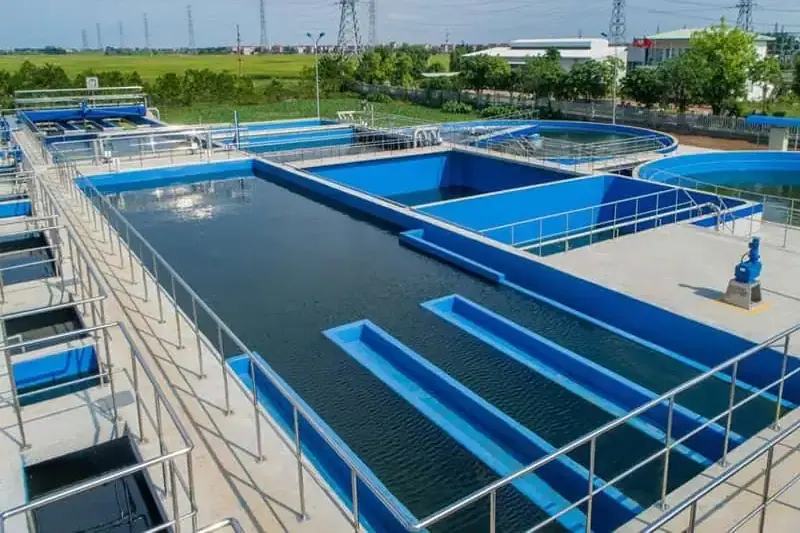
Each route needs its own reactor.
Ozone contactors
Bubble columns, venturi / side-stream injectors or static mixers maximise gas–liquid ozone transfer.
UV reactors
Annular or closed-vessel reactors housing low-pressure (254 nm), medium-pressure or UV-LED lamps.
Fenton reactors
Stirred tanks with acid/base dosing and reagent metering, then neutralisation and solid–liquid separation.
Photocatalytic reactors
Slurry (suspended TiO₂, needs recovery) or immobilised-film reactors; CPC collectors for solar duty.
Electrochemical cells
Plate-and-frame or flow-through cells with BDD, mixed-metal-oxide or carbon electrodes.
Kinetics, energy and the operating levers.
Reaction kinetics
Pollutant decay is well described by pseudo-first-order kinetics. A characteristic feature: parent-compound removal outpaces TOC removal — the molecule fragments quickly, but full mineralisation lags as intermediates resist further attack.
Energy per order (EE/O)
The Electrical Energy per Order — kWh to reduce a pollutant by one order of magnitude in 1 m³ — is the universal AOP benchmark. Reagent-light routes are often more efficient than UV-intensive ones, but the best choice is matrix-specific.
Where AOPs earn their place.
Advantages
Limitations
Destroy, don't relocate.
Correctly applied, AOPs destroy rather than relocate pollutants — supporting water reuse and discharge compliance. Strong oxidants demand engineered handling.
Reactive reagents
Ozone (toxic gas), concentrated H₂O₂ (exothermic decomposition) and Fenton acids demand engineered handling, monitoring and relief.
By-product control
Ozonation can form bromate from bromide; chloride can yield chlorinated by-products — both must be monitored and controlled.
UV & electrical hazards
UV exposure and high-voltage ozone / electrochemical equipment require shielding and interlocks.
Residual management
Quench excess peroxide, destroy ozone off-gas, recover catalysts and dewater iron sludge before discharge.
The primary, non-selective oxidising species of most AOPs (E ≈ 2.80 V).
Selective, longer-lived oxidant of persulfate / PMS-based AOPs (E ≈ 2.5–3.1 V).
Complete conversion of organics to CO₂, H₂O and inorganic ions.
Oxygen-demand and organic-carbon indicators of pollutant load and mineralisation.
Electrical Energy per Order — kWh to cut a pollutant by one order of magnitude (90%) per m³.
Moles of species reacted per mole of photons absorbed (photochemical AOPs).
UV energy delivered per unit area (mJ/cm²).
Ratio of •OH exposure to O₃ exposure — characterises ozone-based AOPs.
Loss of radicals to non-target water constituents (carbonate, NOM).
Destroy the recalcitrant fraction — then hand off to cheaper polishing.
Advanced Oxidation Processes destroy refractory, toxic and non-biodegradable pollutants by generating powerful, non-selective radicals — chiefly the hydroxyl radical (•OH), and increasingly the sulfate radical (SO₄•⁻) — in situ, ideally mineralising contaminants to CO₂, water and inorganic ions. The technology spans many variants differing mainly in how the radical is produced and whether light is required.
Engineering success depends on matching the AOP to the water matrix and target pollutant, managing scavengers and by-products, and — most importantly — using the AOP only for the fraction that needs it: a short, intense oxidation step coupled with cheaper biological or adsorption polishing for cost-effective, compliant treatment.