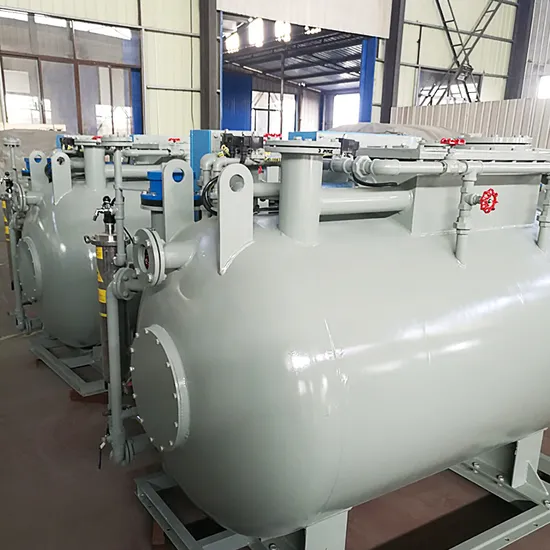
Division II · Spent Caustic
Technical Description · Treatment Technology

Wet Air Oxidation

for Spent Caustic Treatment

A thermal–chemical process that oxidises the sulfides, mercaptans and organic contaminants in spent caustic with air at elevated, subcritical temperature and pressure — water held liquid as the reaction medium — converting a toxic, odorous, high-COD waste into a benign, biodegradable effluent.

DOCUMENTKMS-WAO-001 · REV B
70–95%
COD destruction
≈ 0
Residual sulfide
200–280°C
Reactor temperature
40–120 bar
Operating pressure
01 · The Challenge 02 · The Principle 03 · Reaction Chemistry 04 · Critical-Point Physics 05 · Process Variants 06 · Process Scheme 07 · Reactor & Materials 08 · Design Calculations 09 · Performance 10 · Safety & Environment
01 · The challenge

What spent caustic is, and why it resists treatment.

Spent caustic is the exhausted aqueous sodium hydroxide (NaOH) solution generated when fresh caustic soda scrubs acidic and sulfur-bearing contaminants from hydrocarbon gas and liquid streams. As it absorbs those contaminants, the free NaOH is progressively converted to sodium salts until the solution loses its scrubbing capacity and must be discharged.

The result is highly alkaline (pH 12–14), chemically reduced, malodorous, and carries a very high oxygen demand.

Principal sources
Ethylene / olefin steam crackers — CO₂ and H₂S removed from cracked gas
Refinery LPG, gasoline, jet & kerosene sweetening (Merox-type)
Natural gas and LPG treating units
Three classic categories
Type
Dominant contaminants
Typical origin
Sulfidic
Sodium sulfide (Na₂S), sodium hydrosulfide (NaHS), mercaptides (RSNa)
Ethylene plants, gas treating
Naphthenic / Cresylic
Naphthenic acids, cresols, phenolates
Refinery distillate treating
Phenolic
Phenols, cresols, thiophenols
Gasoline / kerosene treating
Why it is difficult to treat

Very high COD

Often 10,000–100,000+ mg/L — an extreme oxygen demand far beyond conventional treatment.

Toxic sulfides

Corrosive, odorous and acutely harmful to biological systems; release H₂S if acidified.

High pH & salinity

pH 12–14 inhibits conventional biology and is not directly dischargeable.

Reduced sulfur & organics

Both a pollution load and a safety / odour hazard.

02 · The principle

Oxidation in the liquid phase, below the critical point of water.

In Wet Air Oxidation, dissolved and suspended organic and oxidisable inorganic species are oxidised by molecular oxygen — supplied as air or oxygen-enriched air — at elevated temperature and pressure, while the water is deliberately kept in the liquid phase.

The defining principle

The system operates below the critical point of water (374 °C, 22.1 MPa). Pressure is held high enough to keep water liquid at the chosen temperature.

This liquid water acts as both the reaction medium and a heat-transfer / temperature-moderating medium, allowing oxidation to proceed in solution rather than as combustion. WAO is historically known as the Zimmermann process — commercialised as Zimpro®.

Two governing regimes
01
Gas–liquid mass transfer

Oxygen must transfer from air bubbles into the aqueous phase before it can react.

02
Intrinsic reaction kinetics

The chemical oxidation rate of the dissolved contaminants, once oxygen is available.

Good reactor design keeps the process reaction-limited — never starved of oxygen by poor mass transfer.
03 · Reaction chemistry

A free-radical chain that drives sulfur to sulfate and organics to biodegradable acids.

→ Initiation

Reactive radicals — hydroxyl •OH and hydroperoxyl •OOH — form from O₂ and organic molecules.

→ Propagation

Radicals attack organics, breaking them into smaller fragments and generating new radicals.

→ Termination

Radicals recombine, ending the chain.

General degradation pathway
Complex organics → Oxygenated intermediates → Carboxylic acids (acetic, formic, oxalic) → CO₂ + H₂O

An engineering reality: short-chain acids — especially acetic acid — are refractory. Complete mineralisation is energy-intensive, so WAO of spent caustic is run as a partial oxidation: destroy the sulfides and toxic organics, and convert the residual COD into readily biodegradable compounds for downstream biological polishing.

Sulfide oxidation — the primary target

Sulfide oxidation is sequential, passing through intermediate oxidation states of sulfur. Thiosulfate is the typical intermediate; with sufficient temperature, oxygen and residence time it is driven on to sulfate — stable, non-toxic, non-odorous and non-oxygen-demanding.

S²⁻ Sulfide → S₂O₃²⁻ Thiosulfate → SO₃²⁻ Sulfite → SO₄²⁻ Sulfate
Representative reactions
Partial oxidation → thiosulfate (lower severity)
2 Na₂S + 2 O₂ + H₂O → Na₂S₂O₃ + 2 NaOH
Complete oxidation → sulfate (higher severity)
Na₂S + 2 O₂ → Na₂SO₄
Hydrosulfide → sulfate
2 NaHS + 4 O₂ → Na₂SO₄ + H₂SO₄
Mercaptans → disulfides
2 RSH + ½ O₂ → RSSR + H₂O
Phenol ring-opening cascade
Phenols → quinones → muconic acid → acids → CO₂

Exothermic

Oxidation releases heat — roughly 435 kJ per mole of O₂ consumed. High-strength feeds can sustain autothermal operation once started.

Temperature is the lever

Kinetics are first-order in organic concentration and follow Arrhenius — each ~10 °C rise roughly doubles the rate.

k = A · exp(−Eₐ / R·T)
04 · Critical-point physics

Why pressure is mandatory — the liquid-phase demand.

The single thermodynamic concept that separates conventional WAO from supercritical SCWO: where the operating point sits relative to water's critical point.

Regime 01

Compressed liquid

T below local boiling point

Ordinary liquid water.

Regime 02

Saturated / two-phase

On the vapour-pressure curve

Liquid and steam coexist — boiling.

WAO domain

Subcritical pressurised liquid

150–320°C · P above saturation

Hot and reactive yet still liquid — exactly what WAO exploits.

SCWO domain

Supercritical water (SCW)

T > 374°C and P > 22.1 MPa

Neither liquid nor gas — a single dense phase with tunable properties.

Saturation pressure of water

System pressure must always exceed water's saturation pressure at the operating temperature. This is why WAO reactors run at 40–150 bar — to suppress boiling and keep the reaction medium liquid.

Temperature
Saturation pressure
150°C
≈ 0.48 MPa (4.8 bar)
200°C
≈ 1.55 MPa (15.5 bar)
250°C
≈ 3.97 MPa (39.7 bar)
300°C
≈ 8.59 MPa (85.9 bar)
374°C (≈Tc)
≈ 22.1 MPa (Pc)
Water properties through the critical region

Once both T₃ and P₃ are exceeded, water's properties shift dramatically — density and dielectric constant collapse, gases become fully miscible, and salts precipitate. The latter is the chief penalty of SCWO for sodium-rich spent caustic.

Property
Ambient 25°C
Subcritical WAO ≈260°C
Near-critical ≈374°C
Supercritical ≈500°C
Phase
Liquid
Compressed liquid
Critical
Supercritical fluid
Density (kg/m³)
≈ 997
≈ 780
≈ 322
≈ 90–110
Dielectric ε
≈ 78
≈ 25
≈ 6
≈ 2
Ionic product pKw
≈ 14.0
≈ 11.2
≈ 13–14
≈ 20–23
O₂ miscibility
Low
Moderate
High
Complete
Salt solubility
High
High
Falling
Very low
T₃ = 373.95 °C · P₃ = 22.064 MPa · ρ₃ ≈ 322 kg/m³. Values are illustrative literature approximations.
05 · Process variants

Where WAO sits in the wet-oxidation family.

For sulfidic spent caustic, standard non-catalytic WAO is the workhorse: sulfide oxidation is relatively easy, and the primary objective — sulfide destruction plus biodegradability — does not require the higher severity of SCWO.

Variant
Temperature
Pressure
Notes
Standard WAO (Zimpro)
150–320°C
2–15 MPa
Air / O₂; subcritical; the mainstream choice for spent caustic.
Catalytic WAO (CWAO)
120–250°C
lower than WAO
Cu/Fe or noble-metal catalysts lower the required severity and improve refractory-acid destruction.
Low-Pressure Wet Ox (LoProx)
90–200°C
< 2 MPa
Often Fe²⁺-catalysed and H₂O₂-assisted; for lower-strength streams.
Supercritical Water Ox (SCWO)
> 374°C
> 22.1 MPa
Above water’s critical point; near-complete destruction but severe corrosion / salt-deposition.

Subcritical WAO vs. supercritical SCWO

The critical point is the dividing line between the two technologies.
Attribute
Subcritical WAO
Supercritical SCWO
Water phase
Pressurised liquid
Supercritical single phase
Temperature
150–320°C
400–650°C
Pressure
2–15 MPa (20–150 bar)
25–30 MPa
Phases present
Gas (air) + liquid
One homogeneous phase
Rate-limiting step
Gas–liquid O₂ transfer
Chemical kinetics only
Reaction time
30–120 min
Seconds to minutes
COD destruction
70–95% (partial)
> 99% (near-complete)
Salt behaviour
Stays dissolved
Precipitates → plugging
Corrosion severity
High
Very high
Best fit for spent caustic
Yes — mainstream
Niche / refractory loads
06 · Process scheme

A continuous WAO plant, from feed tank to bio-polishing.

WAO PROCESS FLOW DIAGRAM · SPENT CAUSTIC KMS-WAO-002 · REV B
SRC
Spent caustic
pH 12–14 feed
→
T-101
Feed tank + skim
screen · de-oil
→
P-201
HP feed pump
plunger / diaphragm
→
E-301
Economiser
feed / effluent HX
→
H-302
Start-up heater
steam / fired
→
R-401
Oxidation reactor
bubble column + air
→
V-501
Cooler / let-down
economiser + PCV
→
S-601
Separator
flash drum
Separator outputs
Off-gas → thermal oxidiser / vent treatment
Treated liquid → biological polishing → discharge
FIRM
KEMISTA
DRAWING
WAO — Spent Caustic
DWG NO.
KMS-WAO-002
REV
B

Heat integration

Cold pressurised feed is preheated by hot reactor effluent in the economiser — enabling near-autothermal operation for high-strength feeds.

Oxygen supply

A multistage compressor delivers air (or O₂-enriched air) at system pressure, dosed to meet or modestly exceed the COD-based oxygen demand.

Effluent polishing

The biodegradable treated liquid is routed to downstream biological treatment for final COD / BOD removal and pH neutralisation before discharge.
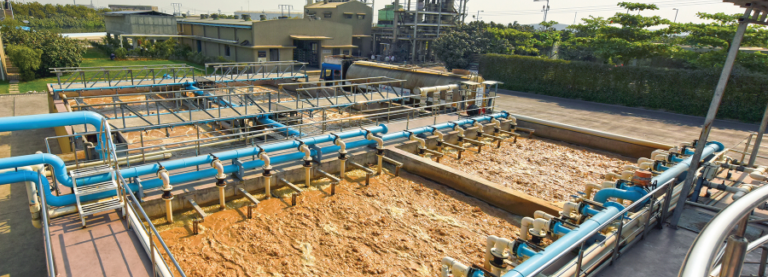
High-pressure process pipework
High-pressure · high-temperature · corrosion-resistant

Engineering success rests on three pillars: severity, oxygen mass transfer, and materials.

07 · Reactor & materials

A vertical bubble-column reactor, built to survive a hot, saline, oxidising environment.

Reactor design priorities

Feed and air enter near the bottom; rising air bubbles provide both oxygen transfer and mixing, and oxidised liquid exits the top.

Sufficient gas–liquid interfacial area for oxygen transfer.
Adequate residence time for the target oxidation.
Plug-flow-like behaviour to avoid short-circuiting.
Heat management of the reaction exotherm.
Typical operating conditions
Temperature 200–280°C (broad 150–320°C)
Pressure 40–120 bar (4–12 MPa)
Residence time 30–120 minutes
Oxidant Air or oxygen-enriched air
COD reduction 70–95%
Sulfide conversion Effectively complete

Materials of construction — corrosion engineering

Zone / component
Conditions
Typical material
Reactor shell & high-severity wetted parts
Hot, oxygenated, chloride/sulfur-bearing
Titanium Gr. 2 (or Ti-lined)
Severe hot spots / injection points
Highest oxidation intensity
Inconel 625 · Hastelloy C-276
High-pressure piping (hot side)
Oxidising, pressurised
Titanium / high-Ni alloy
Economiser (hot side)
Hot effluent
Titanium / duplex / high-Ni
Feed-side & cooler sections
Pre-heat, lower temperature
Stainless 316L / duplex
Off-gas / vapour service
Cooled, condensing acids
Titanium or lined steel

Chlorides are especially damaging — pitting and stress-corrosion cracking — which often dictates titanium even where economics would prefer cheaper alloys.

08 · Design calculations

Conceptual sizing — air, volume and heat.

8.1

Oxygen demand

O₂ ≈ COD load × removal fraction
Air = O₂ / 0.232 × excess

An excess oxygen factor of 10–50% keeps the reaction from being oxygen-limited.

8.2

Reactor volume

ln(C₀ / C) = k · τ
Volume = liquid flow × τ

Higher temperature (smaller reactor, more pressure / material cost) is traded against longer residence time.

8.3

Heat balance

Q = (O₂ consumed) × ΔH
ΔH ≈ 435 kJ / mol O₂

Balanced against feed sensible heat, losses and economiser recovery; strong feeds run autothermal.

09 · Performance

Advantages, limitations, and what the feed becomes.

Advantages

Destroys sulfides and mercaptans almost completely — eliminating toxicity and odour.
Large COD / BOD reduction; converts refractory organics into biodegradable forms.
Closed system: no dilution, no H₂S air-stripping, controlled emissions.
Compact compared with biological systems for high-strength streams.
Energy recovery / autothermal potential for strong feeds.
Handles streams too toxic or concentrated for direct biology or incineration.

Limitations

High capital cost — high-pressure equipment and titanium alloys.
Refractory short-chain acids (acetic) survive; 100% mineralisation is impractical.
Corrosion and scaling demand careful material selection and maintenance.
Operating complexity of high-pressure, high-temperature operation.
Off-gas and effluent salinity (Na₂SO₄ / Na₂CO₃) still require management.
Spent-caustic transformation across WAO
Parameter
Feed (untreated)
After WAO (before bio)
pH
12–14
8–13 (alkaline)
Sulfide (S²⁻)
1,000–40,000 mg/L
≈ 0 (→ sulfate / thiosulfate)
COD
20,000–100,000+ mg/L
70–95% reduction
BOD/COD
Low (toxic, refractory)
Substantially increased
Mercaptans / odour
High
Largely eliminated
Dominant S species
Sulfide / mercaptide
Sulfate (SO₄²⁻), some thiosulfate
Bio-treatability
Poor / inhibitory
Good

Values are representative; actual figures depend on feed type (sulfidic, naphthenic, phenolic) and operating severity.

10 · Safety & environment

A closed, controlled route — by design.

By oxidising sulfide in place, WAO avoids the toxic H₂S release that acidifying untreated spent caustic would cause.

Mechanical integrity

HP/HT operation needs rigorous relief systems and controls; uncontrolled exotherms from hydrocarbon carryover are the key hazard.

H₂S management

WAO oxidises sulfide in place, avoiding the toxic H₂S release that acidifying untreated caustic would cause. Off-gas is monitored and treated.

Effluent quality

Treated liquid is alkaline, low-COD, sulfide-free and biodegradable — suitable for downstream biology and compliant discharge.

Air emissions

Off-gas is essentially spent air plus CO₂; VOC and odour traces are routed to thermal oxidation or vent treatment.

Key technical definitions
COD

Chemical Oxygen Demand — oxygen to chemically oxidise all oxidisable matter; the primary pollutant-load measure.

BOD

Biochemical Oxygen Demand — oxygen consumed by microbes degrading organics; an indicator of biodegradability.

TOC

Total Organic Carbon — carbon content of organic matter; a measure of mineralisation.

ThOD

Theoretical Oxygen Demand — stoichiometric oxygen required for complete oxidation.

BOD/COD ratio

Biodegradability index; WAO aims to raise it so the effluent is bio-treatable.

Residence time

Time the liquid spends in the reactor; a key sizing parameter (typically 30–120 min).

Severity

The combined effect of temperature, pressure and residence time on the extent of oxidation.

Autothermal

A self-sustaining heat balance where reaction heat covers feed preheating.

Subcritical

Operating below water’s critical point — what distinguishes WAO from SCWO.

In summary

A toxic, high-COD waste, made benign and bio-treatable.

Wet Air Oxidation treats spent caustic by oxidising its sulfides, mercaptans and organic contaminants with air at elevated, subcritical temperature and pressure, with water held liquid as the reaction medium. The dominant chemistry — driving reduced sulfur to sulfate and breaking organics into biodegradable short-chain acids — converts a toxic, odorous, high-COD waste into a benign, low-COD, bio-treatable effluent.

Success hinges on three pillars: adequate severity to meet treatment targets, robust oxygen mass transfer in the reactor, and corrosion-resistant materials — notably titanium — to survive the hot, saline, oxidising environment. WAO is normally paired with downstream biological polishing to achieve final discharge specifications.

Have a spent-caustic stream to characterise and treat?

Tell us the type — sulfidic, naphthenic or phenolic — your COD and sulfide loads and discharge consent, and we'll scope a WAO train and the bench / pilot work behind it.

Start a conversation Spent Caustic division